
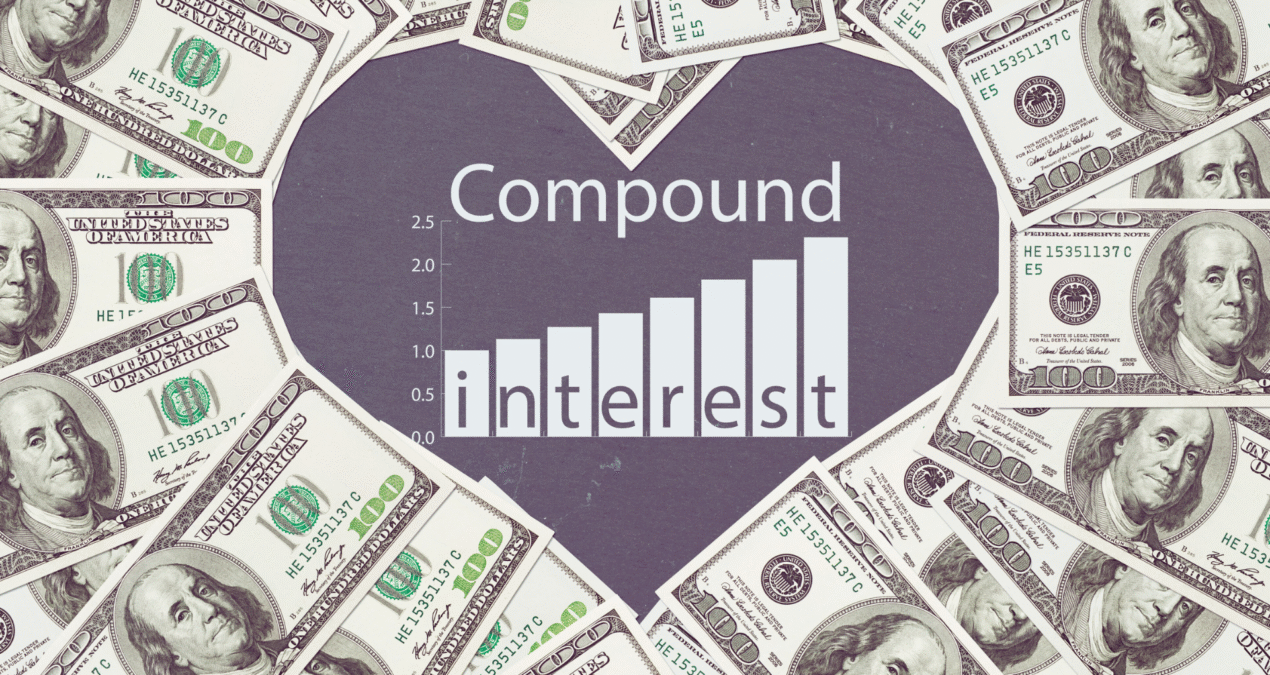
Compound interest is a powerful financial concept that can significantly increase savings over time. It works by earning interest on both the initial principal and the accumulated interest from previous periods. This means that even small amounts invested early can grow substantially due to the compounding effect.
Understanding how compound interest functions is crucial for effective financial planning. By reinvesting earnings, individuals can build wealth faster than they might with simple interest, which only earns returns on the principal. The more frequently interest is compounded, the greater the growth potential.
For those looking to maximise their savings and investments, grasping the mechanics of compound interest can lead to smarter financial decisions. Engaging with this topic provides readers with the tools to make informed choices about their money and future financial health.
Fundamentals of Compound Interest
Compound interest is a crucial concept in finance that determines how investments grow over time. By understanding the relationships between principal, interest rates, and the compounding process, individuals can make informed financial decisions.
Understanding Principal and Interest
The principal is the initial amount of money invested or borrowed. This sum forms the foundation for accruing interest.
Interest, in this context, refers to the cost of borrowing money or the return received on an investment. It can be expressed as a percentage of the principal.
For instance, if an investor places $1,000 in a savings account with an interest rate of 5%, the interest for the first year would be $50. As interest accrues, it can be added to the principal for future calculations, illustrating the power of compound interest.
Difference Between Simple and Compound Interest
Simple interest is calculated solely on the principal amount. This means it remains constant throughout the investment period.
In contrast, compound interest calculates interest on the accumulated interest as well as the principal. This results in exponential growth over time.
For example, with simple interest, if an individual has an investment of $1,000 at a 5% rate for three years, they will earn $150. In comparison, compound interest on the same principal and interest rate could yield approximately $157.63 after three years due to interest compounding annually.
The Role of Interest Rates
Interest rates significantly impact the growth of investments. They are typically expressed as an annual percentage and can vary widely depending on market conditions, risk factors, and the financial institution.
A higher interest rate means more earnings for investments. For example, an investment of $1,000 at a 5% interest rate compounds to different amounts based on the frequency of compounding (annually, semi-annually, quarterly, or monthly).
To illustrate, an investment compounded annually will earn $1,050 after one year, while one compounded monthly will be slightly higher due to more frequent calculations. Therefore, understanding how interest rates affect compounding is essential for maximising investment returns.
How Compound Interest Is Calculated
Understanding how compound interest is calculated involves recognising the significance of compounding periods, the formula used, and the availability of calculators to simplify the process. Each of these elements plays a crucial role in determining the final amount accumulated over time.
Compounding Periods and Frequency of Interest Payments
Compounding periods refer to the intervals at which interest is applied to the principal balance. Common compounding periods include annual, semi-annually, quarterly, monthly, and daily.
For example, if interest is compounded monthly, the interest earned is added to the principal each month. This results in a higher effective rate of return because interest is earned on interest more frequently.
The frequency of interest payments affects the total amount accumulated. More frequent compounding leads to higher overall returns. Therefore, understanding the chosen compounding period is essential for accurate financial planning.
Compound Interest Formula
The formula for calculating compound interest is:
[ A = P times (1 + frac{r}{n})^{nt} ]
Where:
- A = the future value of the investment/loan, including interest.
- P = the principal amount (the initial deposit or loan amount).
- r = annual interest rate (decimal).
- n = number of times that interest is compounded per unit time.
- t = time the money is invested or borrowed for, in years.
By substituting the appropriate values, one can determine how much the investment will grow over a specified period. This formula highlights the impact of both the interest rate and the compounding frequency on the total amount accumulated.
Using Compound Interest Calculators
Compound interest calculators are tools that simplify the calculations involved in determining future investment values. These online calculators allow users to input the principal balance, interest rate, compounding frequency, and time period.
Upon entering these values, the calculator computes the accumulated amount quickly. Many calculators also provide a breakdown, showing how much of the final amount is interest versus the initial investment.
Using such tools can significantly reduce errors related to manual calculations and help visualise different investment scenarios effectively. They are essential for anyone looking to understand and optimise their investments.
Practical Applications of Compound Interest
Compound interest plays a crucial role in various financial strategies, enhancing both savings and investments. Understanding its applications can lead to more effective financial planning and wealth accumulation.
Growing Your Savings With Compound Interest
Compound interest significantly benefits those who prioritise saving early in their lives. When individuals place money into a savings account, the interest they earn is added to their principal balance. This means that future interest calculations are based on the new total amount, leading to accelerated growth.
For instance, if someone saves $1,000 with an annual interest rate of 5%, the first year earns $50 in interest. In the second year, interest is calculated at $1,050, resulting in $52.50 earned. Over time, this can result in substantial gains, making it advantageous to start saving as early as possible.
Compound Interest in Investments
Investors can leverage compound interest to enhance their investment portfolios. This is particularly true in accounts like 401(k)s or IRAs, where funds grow tax-deferred. Reinvesting dividends further amplifies the compounding effect.
For instance, consider an investment of $10,000 with a 7% annual return. Over ten years, assuming no additional contributions, the investment can grow to approximately $19,671. The reinvestment of gains allows the initial capital to earn returns on both the principal and accrued interest, showcasing how compounding plays a vital role in building wealth.
The Power of Compounding Over Time
The longer one allows their money to compound, the more powerful the growth becomes. Even small, regular contributions can have a significant impact when compounded over many years.
For example, if an individual contributes $2,000 annually into an investment account with a 6% return, after 30 years, they could accumulate around $248,000. This demonstrates the substantial gain that can result from consistent contributions and the effects of compounding.
In essence, the power of compounding can transform personal finances when harnessed effectively.
Compound Interest and Debt
Compound interest significantly affects how debt accumulates over time. It can lead to rapid increases in the amount owed, especially with high interest rates associated with credit cards and certain loans.
Credit Card Debt and Compound Interest
Credit card debt often features high-interest rates that compound monthly. When a user carries a balance, interest accrues not just on the initial amount but also on any previously accumulated interest.
For example, if a person has a $1,000 balance with a 20% annual interest rate, the monthly rate is about 1.67%. If payments are not made, the balance grows:
|
Month |
Balance | Interest Charged |
|
1 |
$1,000 | $16.67 |
| 2 |
$1,016.67 |
$16.94 |
| 3 | $1,033.61 |
$17.22 |
This illustrates how quickly debt can spiral.
Loans, Withdrawals, and Their Impact
Loans with compound interest can also escalate quickly if not managed properly. Personal loans, student loans, and mortgages may have varying compounding periods (monthly, quarterly, annually), impacting total interest paid over time.
Additionally, when a borrower makes a withdrawal on a loan, the interest may apply to the new total balance, compounding further.
For instance, if an individual withdraws additional funds from a line of credit, the interest on the increased balance may accumulate rapidly, leading to higher repayment amounts in the future.
Understanding these dynamics helps borrowers make informed decisions and manage their finances effectively.